Hardening is an important
heat treatment process used to improve the hardness, strength, wear resistance, and service life of metal components. For manufacturers producing precision tools, dies, moulds, automotive components, and other engineered parts, selecting the right hardening process can have a direct impact on component quality and performance.
Two commonly used approaches are
conventional hardening and
vacuum hardening. While conventional hardening remains suitable for many applications,
vacuum heat treatment offers significant advantages when surface quality, dimensional stability, and process consistency are critical.
So, which process is better for precision components? The answer depends on the material, component geometry, required hardness, dimensional tolerances, and application. This article compares both processes and explains when high-quality vacuum hardening can be the preferred choice.
What Is Conventional Hardening?
Conventional hardening involves heating a metal component to a specific temperature, holding it at that temperature for a controlled period, and then rapidly cooling or quenching it using a suitable medium such as oil, water, or polymer.
After hardening, tempering may be carried out to achieve the required balance between hardness and toughness.
Although conventional hardening can deliver the required metallurgical properties, components may be exposed to atmospheric conditions during heating. This can result in oxidation, scaling, surface reactions, and, depending on the material and geometry, dimensional changes or distortion.
For components that will undergo further machining or surface finishing, these effects may be manageable. However, they can become more significant when manufacturing precision components with tight tolerances and demanding surface-finish requirements.
What Is Vacuum Hardening?
Vacuum hardening is a controlled heat treatment process performed in a vacuum furnace. By removing or significantly reducing atmospheric gases during heating, the process minimizes oxidation and contamination of the component surface.
The process generally involves controlled heating, soaking at the required temperature, and controlled cooling or gas quenching. Tempering can then be performed according to the material and required mechanical properties.
A major advantage of vacuum hardening is the ability to maintain a controlled processing environment. This makes it particularly suitable for components where cleanliness, dimensional accuracy, surface quality, and repeatability are important.
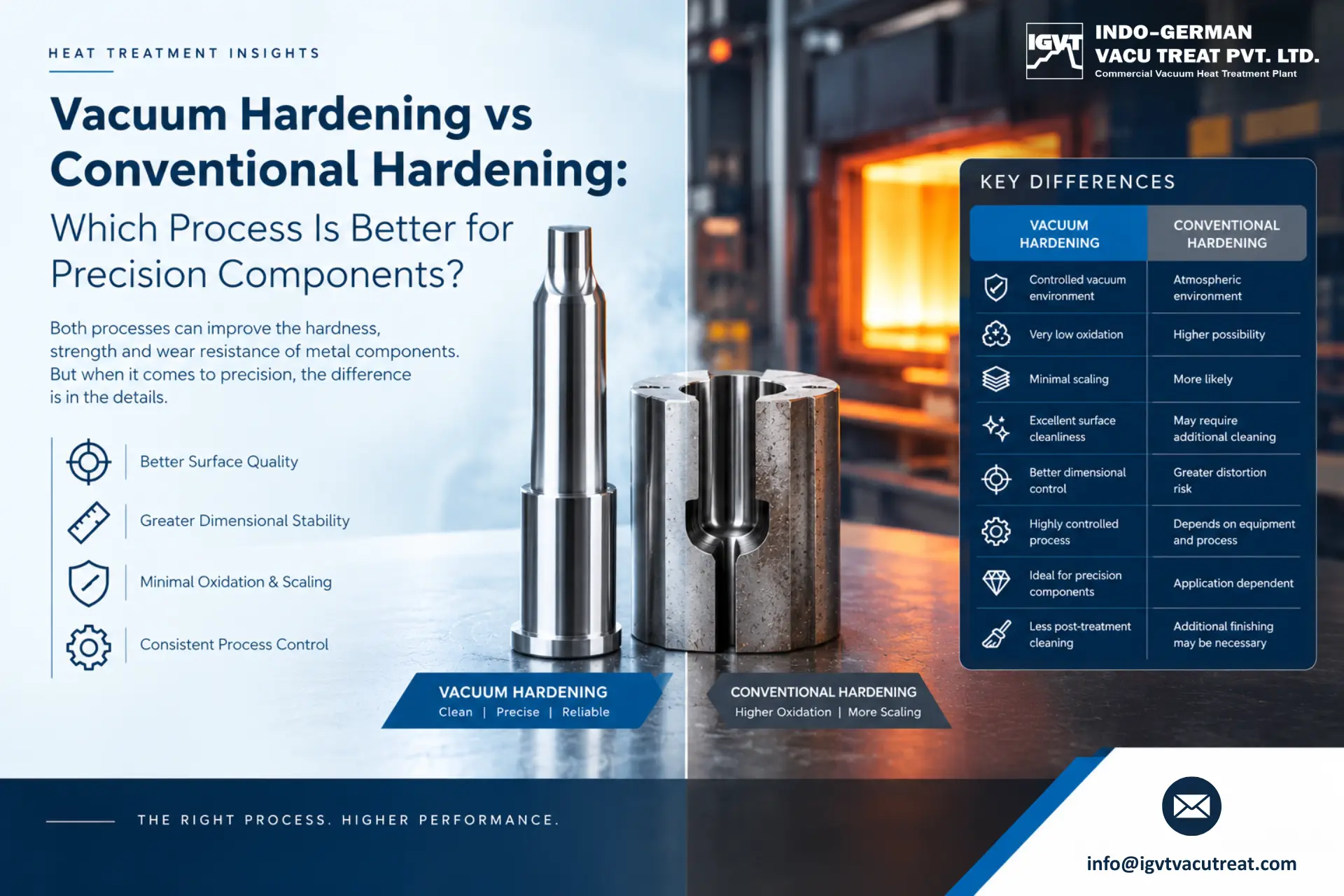
Vacuum Hardening vs Conventional Hardening
The main differences can be summarized as follows:
|
Factor
|
Vacuum Hardening
|
Conventional Hardening
|
|
Heating environment
|
Controlled vacuum
|
Atmospheric environment in many processes
|
|
Oxidation
|
Very low when properly controlled
|
Higher possibility
|
|
Scaling
|
Significantly reduced
|
More likely
|
|
Surface cleanliness
|
Excellent
|
May require additional cleaning
|
|
Dimensional control
|
Generally better
|
Can have greater distortion risk
|
|
Process control
|
Highly controlled
|
Depends on equipment and process
|
|
Precision components
|
Highly suitable
|
Application dependent
|
|
Surface finishing
|
Less post-treatment cleaning may be required
|
Additional finishing may be necessary
|
The choice should not be based solely on the technology. Material grade, component design, hardness requirements, tolerances, and production requirements should all be considered.
Benefits of High Quality Vacuum Hardening
1.Reduced Oxidation and Scaling
One of the
key benefits of vacuum heat treatment is reduced exposure to oxygen during heating. This helps minimize oxidation and scaling, allowing components to retain a cleaner surface after treatment.
2.Better Dimensional Stability
Precision components often require tight dimensional tolerances. Controlled heating and cooling conditions in vacuum hardening can help reduce distortion and dimensional variation when the process is properly designed for the component.
3.Improved Surface Quality
Because vacuum processing minimizes oxidation and contamination, components can achieve a cleaner surface finish compared with processes where significant scaling occurs. This can reduce the need for certain post-treatment cleaning or finishing operations.
4.Consistent Processing
Modern vacuum furnaces provide precise control over temperature, vacuum conditions, heating cycles, and quenching parameters. This level of control can support repeatable results across production batches.
5.Improved Component Performance
Correctly selected and controlled hardening can increase hardness and wear resistance, helping components perform reliably under demanding operating conditions.
When Is Vacuum Hardening the Better Choice?
High quality vacuum hardening can be particularly beneficial for applications where surface condition and dimensional accuracy are critical.
Typical applications include:
- Precision tools and dies
- Mould components
- Cutting tools
- Automotive components
- Aerospace components
- High-speed steel components
- Tool steel components
- Stainless steel components
- Components with tight dimensional tolerances
- Wear-resistant engineering components
For example, a precision die may require high hardness while maintaining its dimensional accuracy and surface quality. In such cases, a
controlled vacuum heat treatment process can offer advantages over conventional processing.
When Can Conventional Hardening Be Suitable?
Conventional hardening is still an effective option for many industrial applications. It may be suitable when:
- Component tolerances are less demanding
- Surface oxidation can be managed
- Additional surface finishing is already planned
- The material and geometry are well suited to conventional processing
- Production requirements allow the associated post-treatment operations
Therefore, vacuum hardening should not automatically replace conventional hardening. The best process should be selected based on the technical requirements of the component.
Factors to Consider When Selecting a Hardening Process
Manufacturers should consider several factors before selecting a heat treatment process:
- Material grade and composition
- Required hardness
- Component geometry
- Dimensional tolerances
- Risk of distortion
- Surface finish requirements
- Wear and service conditions
- Production quantity
- Required process consistency
- Post-treatment machining requirements
- Industry-specific quality requirements
A
professional heat treatment provider can evaluate these factors and recommend an appropriate treatment cycle.
Choosing the Right Vacuum Heat Treatment Services
Selecting the right service provider is just as important as selecting the process. Manufacturers should evaluate the provider's furnace capabilities, technical expertise, quality controls, processing experience, and ability to handle the required component sizes and production volumes.
Important factors include:
- Experience with relevant materials
- Advanced vacuum furnace capabilities
- Controlled heating and quenching systems
- Process monitoring and documentation
- Hardness and quality inspection facilities
- Experience with precision components
- Ability to support commercial production
- Industry-specific technical knowledge
Working with an experienced provider helps ensure that the selected process is aligned with the component's material and performance requirements.
Why Choose IGVT for Vacuum Heat Treatment?
IGVT provides vacuum heat treatment services for industrial applications where controlled processing, surface quality, dimensional stability, and repeatability are important.
With appropriate vacuum processing capabilities and technical expertise, IGVT can support manufacturers requiring reliable heat treatment solutions for precision components. Customers can discuss their material, component geometry, hardness requirements, and application conditions with the technical team to determine a suitable treatment approach.
Frequently Asked Questions
1.What is the difference between vacuum hardening and conventional hardening?
Vacuum hardening is performed in a controlled vacuum environment, helping minimize oxidation and scaling. Conventional hardening may expose components to atmospheric conditions during heating and can result in greater surface oxidation depending on the process.
2.Is vacuum hardening suitable for precision components?
Yes. Vacuum hardening is particularly suitable for components where dimensional stability, surface cleanliness, controlled processing, and repeatability are important.
3.What are the benefits of high quality vacuum hardening?
Key benefits include reduced oxidation and scaling, improved surface quality, better dimensional control, consistent processing, and improved wear resistance when the treatment is correctly selected.
4.Which materials can undergo vacuum hardening?
Various tool steels, alloy steels, high-speed steels, stainless steels, and other suitable engineering materials can be processed using vacuum hardening. The appropriate cycle depends on the specific material grade and component requirements.
5.How do I choose the right vacuum heat treatment service provider?
Consider the provider's furnace capabilities, material expertise, quality control systems, processing experience, inspection facilities, and ability to meet your required specifications and production volumes.
Conclusion
Both conventional and vacuum hardening can be effective heat treatment solutions, but their suitability depends on the application. For precision components where surface quality, dimensional stability, cleanliness, and process consistency are important, vacuum hardening can provide significant advantages.
By selecting the appropriate process and working with an experienced provider, manufacturers can achieve the required hardness and performance while maintaining the quality of precision components.
Looking for high quality vacuum hardening for your precision components? Contact IGVT to discuss your component requirements and explore suitable
vacuum heat treatment services for your application.