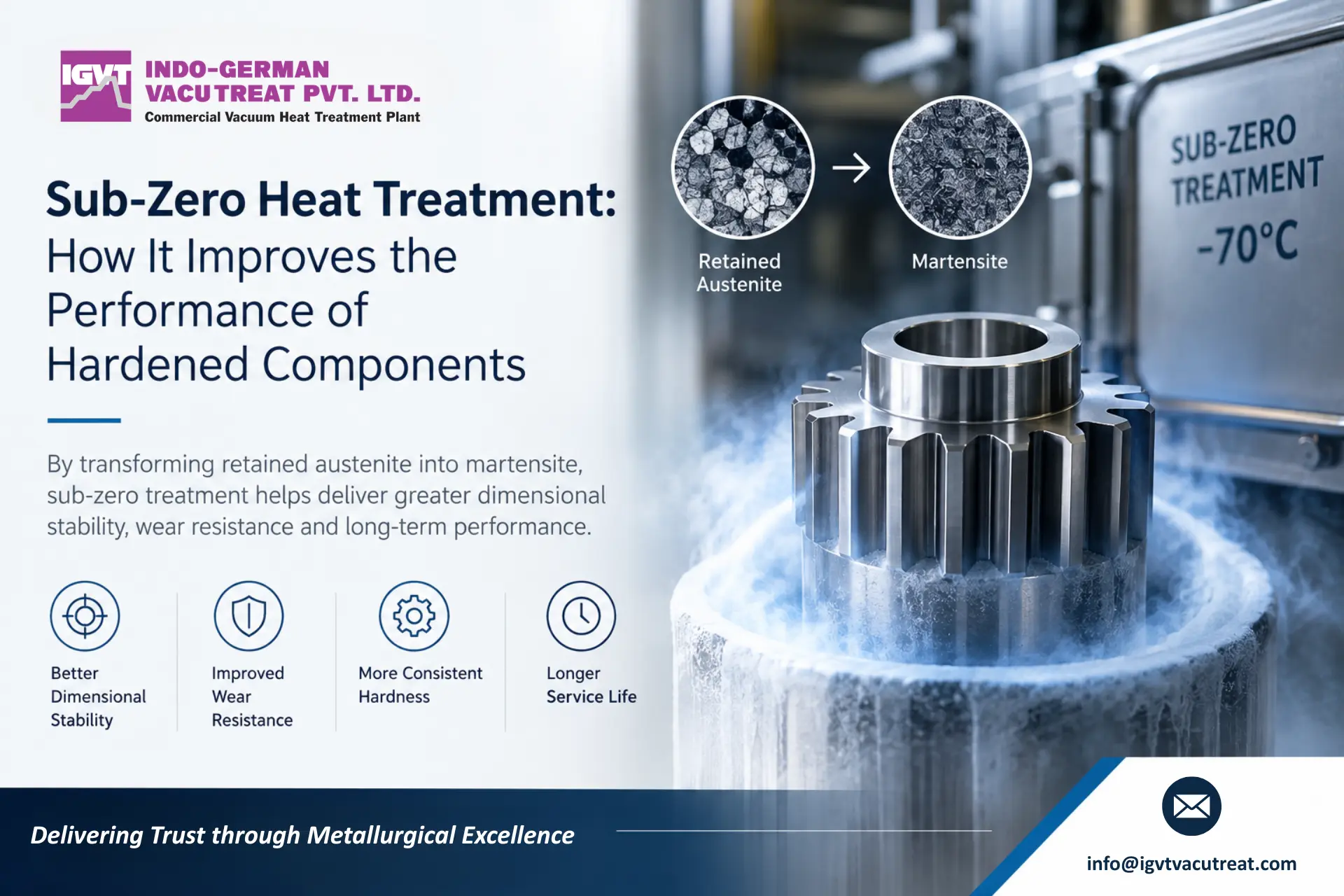
In precision manufacturing, achieving the required hardness is only one part of producing a high-performance component. Hardened steel components may still contain retained austenite, which can affect dimensional stability, wear resistance, and long-term performance. For applications where these factors are critical,
sub zero heat treatment can be an important part of the overall heat treatment process.
Sub-zero treatment is a controlled process performed at temperatures below 0°C, typically after hardening. It is designed to help transform retained austenite into martensite, supporting a more stable microstructure. When combined with appropriate
vacuum heat treatment,
hardening, and tempering processes, it can help manufacturers achieve consistent performance in demanding industrial applications.
What Is Sub-Zero Heat Treatment?
Sub-zero heat treatment is a specialized process in which a hardened component is cooled to a controlled temperature below 0°C and held for a specified period. The exact temperature and holding time depend on factors such as the material grade, component geometry, existing heat treatment cycle, and required properties.
During conventional hardening, steel is heated to a suitable temperature and then rapidly cooled to produce a hard martensitic structure. However, the transformation may not be complete, leaving a certain amount of retained austenite in the component.
Sub-zero treatment can encourage the transformation of this retained austenite into martensite. The resulting microstructural change can be particularly useful for components requiring dimensional stability and consistent wear performance.
Why Is Sub-Zero Treatment Performed After Hardening?
Retained austenite can be relatively unstable compared with the desired hardened structure. Under certain conditions, it may transform during subsequent processing or service.
This transformation can cause changes in component dimensions and properties. Such changes can be problematic for precision components manufactured with tight tolerances.
Sub-zero heat treatment provides an additional step for controlling the microstructure after hardening. By reducing retained austenite, manufacturers can improve the stability and consistency of components where dimensional accuracy and wear performance are important.
How Does Sub-Zero Heat Treatment Work?
A typical sub-zero treatment sequence may include the following stages:
1.Hardening
The component first undergoes an appropriate hardening process. Depending on the material and application,
vacuum heat treatment may be selected to provide a controlled processing environment.
2.Controlled Cooling
After hardening, the component is cooled to a specified sub-zero temperature. Controlled cooling is important to minimize unwanted thermal stresses and maintain process consistency.
3.Holding at Sub-Zero Temperature
The component is maintained at the required temperature for a predetermined period. The process parameters should be selected according to the material and component requirements rather than applying one standard cycle to every component.
4.Controlled Return
After the treatment, the component is returned to a suitable temperature under controlled conditions.
5.Tempering
Tempering may follow sub-zero treatment as part of the
complete heat treatment cycle . It helps achieve the desired balance of hardness, toughness, and dimensional stability.
Role of Retained Austenite in Hardened Components
For some applications, its presence may not create a significant problem. However, in precision components, excessive or unstable retained austenite can contribute to:
Typical applications include:
- Dimensional changes over time
- Microstructural instability
- Variations in hardness
- Reduced wear performance
- Difficulties in maintaining close dimensional tolerances
Sub-zero treatment can help reduce retained austenite by promoting its transformation, making it a valuable process for selected high-performance components.
Key Benefits of Sub-Zero Heat Treatment
Improved Dimensional Stability
For precision components, maintaining dimensions throughout service is critical. Reducing retained austenite can help improve dimensional stability and reduce the risk of unwanted transformation later.
Improved Wear Resistance
A more stable hardened microstructure can support improved wear performance in components exposed to repeated friction or mechanical loads.
More Consistent Hardness
Sub-zero treatment can contribute to a more consistent final microstructure, supporting predictable component performance when integrated with a properly controlled hardening and tempering cycle.
Improved Microstructural Stability
The process can reduce the amount of retained austenite and improve stability during subsequent service.
Longer Component Performance
Better dimensional stability and wear characteristics can help components maintain their functional performance for longer periods, depending on the material and operating conditions.
Sub-Zero Treatment vs. Conventional Hardening
|
Factor
|
Conventional Hardening
|
Hardening + Sub-Zero Treatment
|
|
Hardening
|
Yes
|
Yes
|
|
Retained austenite control
|
Depends on process/material
|
Can be improved
|
|
Dimensional stability
|
Application dependent
|
Can be improved
|
|
Wear performance
|
Material/process dependent
|
Can be improved
|
|
Precision applications
|
Suitable for many components
|
Useful where additional stability is required
|
Sub-zero treatment is therefore not automatically required for every hardened component. Its value depends on the steel grade, component design, dimensional requirements, and expected operating conditions.
Relationship Between Vacuum Heat Treatment and Sub-Zero Treatment
Vacuum heat treatment and sub-zero treatment can form complementary stages of a controlled heat treatment strategy.
Vacuum processing can provide a controlled environment during heating and hardening, helping maintain surface quality and process consistency. Sub-zero treatment can then be introduced when microstructural control and retained-austenite reduction are important
For precision components, the complete process may involve carefully controlled hardening, quenching, tempering, sub-zero treatment, and subsequent tempering or stabilization as required by the material and application.
The objective is not simply to achieve high hardness, but to achieve the right combination of hardness, dimensional stability, wear resistance, and service performance.
Materials and Components That May Benefit
Potential materials include:
- Tool steels
- High-carbon and high-alloy steels
- Selected bearing steels
- Other hardened alloy steels
Potential applications include:
- Dies and tooling
- Cutting tools
- Gears
- Bearings
- Precision machine components
- Wear-resistant components
The suitability of the treatment should always be evaluated based on the specific material grade, component geometry, existing heat treatment process, and performance requirements.
Industries Using Sub-Zero Heat Treatment
Sub-zero heat treatment can be relevant across several industries where precision, durability, and dimensional stability are important.
These include:
- Automotive : gears, transmission components, and precision parts
- Tool & Die : dies, punches, and tooling components
- Aerospace : selected high-performance precision components
- Engineering : machine and wear-resistant components
- Industrial Machinery : components exposed to demanding operating conditions
- Bearing and Transmission Manufacturing: parts requiring dimensional and wear stability
Why High-Quality Vacuum Hardening Matters
Selecting the right heat treatment provider is important when components require controlled and repeatable results. High quality vacuum hardening should involve appropriate process control, material-specific parameters, controlled heating
and cooling, and suitable tempering practices.
When evaluating a service provider, manufacturers should consider:
- Experience with vacuum hardening and sub-zero treatment
- Controlled furnace and cooling processes
- Temperature monitoring and process documentation
- Knowledge of different steel grades
- Capability to process precision components
- Quality inspection and testing practices
- Ability to develop processes according to component requirements
A complete heat treatment solution should focus on the component's required performance rather than simply achieving a specified hardness value.
When Should Manufacturers Consider Sub-Zero Treatment?
Sub-zero treatment may be worth considering when components have:
- Tight dimensional tolerances
- High wear requirements
- Critical dimensional stability requirements
- Potential retained-austenite concerns
- Demanding service conditions
- Precision tooling or die applications
A material and application-specific assessment should be performed before introducing the process.
FAQs – Sub-Zero Heat Treatment
1.What is sub-zero heat treatment?
Sub-zero heat treatment is a controlled process performed below 0°C after hardening. It helps transform retained austenite into martensite, which can improve dimensional stability and support consistent performance in selected hardened components.
2.Why is sub-zero treatment used after hardening?
Sub-zero treatment is used when controlling retained austenite is important. It can help improve dimensional stability, microstructural stability, and wear performance in components with demanding precision or service requirements.
3.How does sub-zero heat treatment improve component performance?
By promoting the transformation of retained austenite, sub-zero treatment can contribute to a more stable hardened microstructure. Depending on the material and application, this can support improved wear resistance, dimensional stability, and consistency during service.
4.What components can benefit from sub-zero heat treatment?
Components that may benefit include precision tooling, dies, cutting tools, gears, bearings, and selected wear-resistant machine components. The suitability depends on the material grade, component geometry, tolerances, and required performance.
5.Can sub-zero treatment be combined with vacuum heat treatment?
Yes. Sub-zero treatment can be incorporated into a broader heat treatment cycle that includes vacuum heat treatment, hardening, quenching, and tempering when appropriate for the material and application.
6.Is sub-zero heat treatment required for every hardened component?
No. It is not necessary for every application. The requirement depends on factors such as retained austenite, dimensional tolerances, wear requirements, material grade, and operating conditions.
7.What is the difference between sub-zero treatment and vacuum hardening?
Vacuum hardening is a controlled hardening process carried out in a vacuum environment, while sub-zero treatment is a subsequent low-temperature treatment used primarily to help control retained austenite. Both can be part of a comprehensive heat treatment process.
8.How do I choose a sub-zero heat treatment service provider?
Look for a provider with experience in sub zero heat treatment, vacuum heat treatment, and high quality vacuum hardening, along with controlled processing, appropriate equipment, temperature monitoring, quality inspection, and experience with precision components.
Conclusion
Sub zero heat treatment is a valuable specialized process for selected hardened components where dimensional stability, wear performance, and microstructural stability are important. By helping transform retained austenite, the process can complement conventional hardening and tempering.
When integrated with controlled vacuum heat treatment and high quality vacuum hardening, sub-zero treatment can form part of a comprehensive approach to producing reliable, high-performance precision components.
For manufacturers, the key is to select the appropriate process based on the material, component geometry, dimensional requirements, and intended application rather than treating sub-zero processing as a universal requirement.
Looking for reliable sub-zero heat treatment and high quality vacuum hardening for precision components? Contact IGVT to discuss your component material, application, and heat treatment requirements.