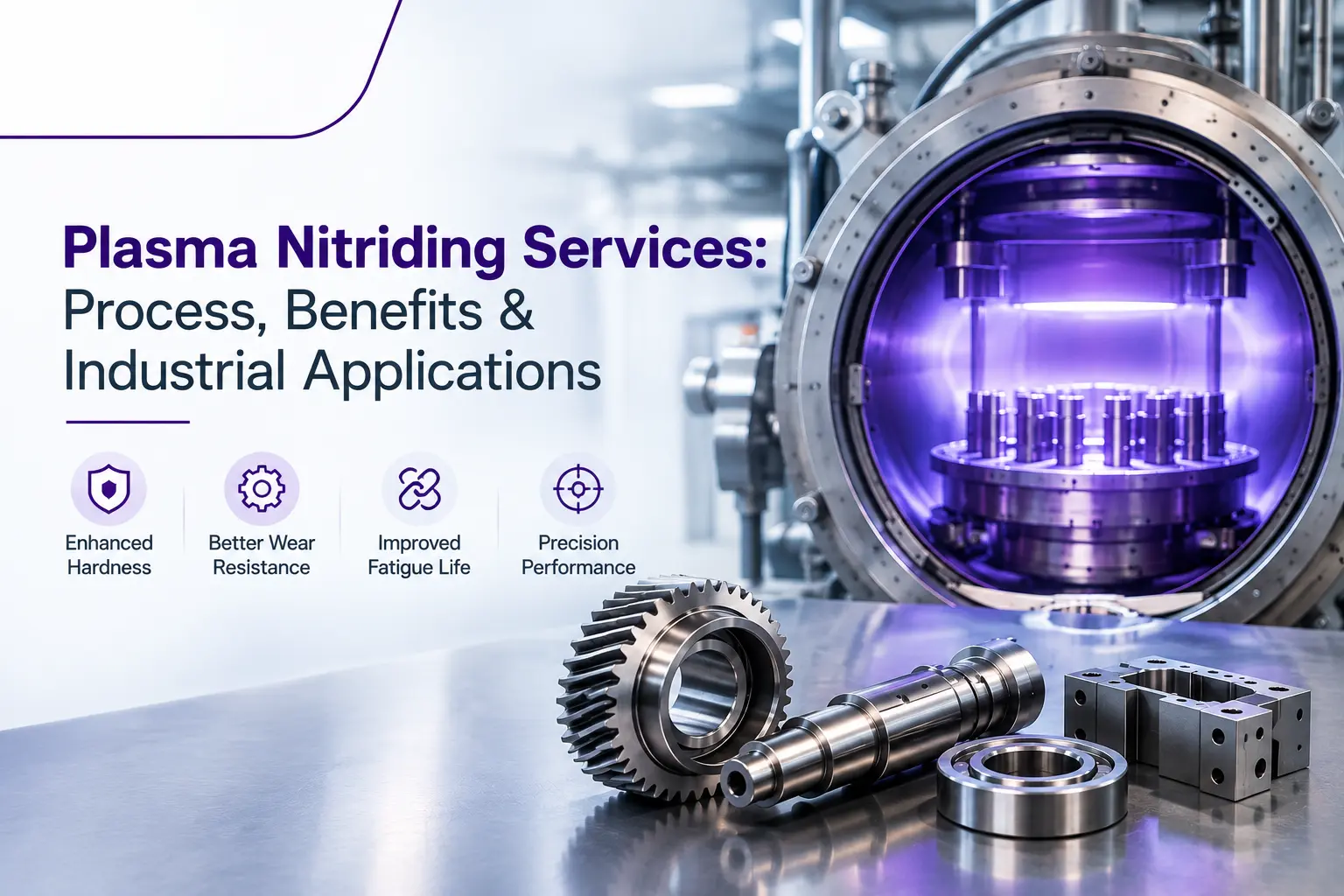
Plasma nitriding is an
advanced surface treatment process used to improve the performance of suitable metal components. It increases surface hardness and can enhance wear resistance, fatigue performance, and overall component durability without significantly changing the properties of the component core.
For manufacturers working with precision tools, dies, gears, shafts, moulds, and other wear-critical components, selecting the right surface treatment can have a major impact on product performance and service life. Professional
plasma nitriding services provide a controlled method for modifying the component surface according to specific application requirements.
This article explains the plasma nitriding process, its benefits, materials, industrial applications, and what manufacturers should consider when selecting a service provider.
What Is Plasma Nitriding?
Plasma nitriding is a thermochemical surface treatment process in which nitrogen is introduced into the surface of a metal component in a controlled low-pressure environment.
During the process, an electrical discharge creates plasma containing active nitrogen species. These nitrogen species interact with the component surface, allowing nitrogen to diffuse into the material. Depending on the material composition and process parameters, this can produce a hardened surface layer with improved wear and performance characteristics.
Unlike conventional bulk hardening processes, plasma nitriding primarily modifies the surface while retaining the desired properties of the component core.
The process is particularly useful for components that require a combination of surface hardness, wear resistance, dimensional control, and service durability.
How Does the Plasma Nitriding Process Work?
A controlled plasma nitriding cycle generally involves several stages.
1. Component Cleaning
Components are thoroughly cleaned before treatment. Oil, grease, dirt, and other contaminants must be removed because surface contamination can affect the consistency of the nitriding process.
Proper preparation also helps ensure uniform contact between the component surface and the plasma.
2. Component Loading
The cleaned components are positioned inside the plasma nitriding furnace. Proper arrangement is important to support uniform treatment across the component surfaces.
The loading method can depend on component geometry, size, quantity, and required treatment conditions.
3. Creating the Vacuum Environment
The furnace chamber is evacuated to establish the required low-pressure environment. This controlled environment is an important part of the plasma nitriding process.
4. Plasma Generation
Suitable nitrogen-containing process gases are introduced into the chamber. An electrical discharge is then used to generate plasma around the components.
The active nitrogen species created within the plasma interact with the component surface.
5. Controlled Nitriding
The components are maintained at the specified treatment temperature and process conditions.
Nitrogen diffuses into the surface, producing the required hardened layer. Temperature, gas composition, pressure, treatment time, and other parameters are controlled according to the material and desired results.
6. Cooling
After the nitriding cycle is completed, the components are cooled under controlled conditions.
The cooling procedure depends on the material, component geometry, and processing requirements.
7. Inspection
After treatment, components can be inspected according to the applicable specifications. Depending on requirements, inspection may include surface hardness, dimensional checks, appearance, and evaluation of the treated layer.
Key Benefits of Plasma Nitriding
Improved Surface Hardness
Plasma nitriding can significantly improve the surface hardness of suitable steels. A harder surface can provide better resistance against wear during service.
Better Wear Resistance
Components operating under friction or repeated contact can benefit from improved surface properties. Plasma nitriding can help reduce surface wear in suitable applications.
Improved Fatigue Performance
Properly controlled nitriding can improve fatigue performance for certain materials and component designs, making it useful for components exposed to repeated mechanical loading.
Controlled Surface Treatment
The process allows treatment parameters to be controlled according to the material and application requirements. This provides manufacturers with greater flexibility in developing the required surface characteristics.
Suitable for Precision Components
For suitable applications,
plasma nitriding can provide surface enhancement while helping maintain dimensional stability. However, actual dimensional changes depend on material, geometry, preparation, and process conditions.
Extended Component Service Life
Improved
surface hardness and wear resistance can contribute to longer component service life, reducing the frequency of replacement or maintenance in appropriate applications.
Which Materials Can Be Plasma Nitrided?
Plasma nitriding is commonly applied to various alloyed steels, although the suitability depends on the specific material grade and application.
Examples may include:
- Tool steels
- Die steels
- Alloy steels
- Stainless steels
- Selected engineering steels
The chemical composition of the material is important because alloying elements can influence nitrogen diffusion and the formation of nitrides.
Before processing, manufacturers should confirm that the selected material and its previous heat treatment condition are compatible with the intended nitriding cycle.
Industrial Applications of Plasma Nitriding
Plasma nitriding is used across industries where components require improved surface performance.
Automotive Industry
Automotive components such as gears, shafts, dies, and other wear-critical parts can benefit from surface treatments designed to improve hardness and wear resistance.
Tool & Die Industry
Plasma nitriding is widely considered for suitable dies, moulds, forming tools, and tooling components where surface durability is important.
Aerospace
Selected
aerospace components may require high-performance surface treatments to withstand demanding operating conditions. Plasma nitriding can be considered for suitable materials and applications.
General Engineering
Machine components, shafts, bushes, gears, and other precision engineering parts may use nitriding to improve surface performance and durability.
Plasma Nitriding vs Conventional Nitriding
Both plasma nitriding and conventional nitriding are surface treatment technologies, but their processing environments and methods differ.
| Factor |
Plasma Nitriding |
Conventional Nitriding |
| Environment |
Controlled low-pressure plasma environment |
Depends on nitriding method |
| Process control |
Highly controlled |
Process dependent |
| Surface treatment |
Precisely controlled |
Depends on process |
| Oxidation control |
Controlled processing environment |
Depends on method |
| Precision applications |
Suitable for many applications |
Application dependent |
| Process flexibility |
Parameters can be adjusted |
Depends on technology |
The best treatment depends on the material, component geometry, required surface properties, production volume, and operating conditions.
How to Choose the Right Plasma Nitriding Services
Selecting a technically capable provider is essential for achieving consistent results. Manufacturers looking for
plasma nitriding services should evaluate several factors before making a decision.
Important considerations include:
- Plasma nitriding furnace capabilities
- Experience with the required material
- Component size and furnace capacity
- Temperature and process control
- Gas and atmosphere control
- Surface hardness testing
- Case-depth evaluation where required
- Dimensional inspection
- Quality management systems
- Process documentation
- Experience with relevant industrial applications
A professional service provider should also understand the relationship between material composition, prior heat treatment, component geometry, and nitriding parameters.
Finding Plasma Nitriding in Pune
Pune is an important manufacturing and engineering hub, with companies operating across automotive, tooling, engineering, and industrial sectors.
Manufacturers searching for
plasma nitriding in Pune should look beyond location alone when selecting a treatment provider. Technical expertise, equipment capability, quality inspection, process consistency, and experience with similar components should all be evaluated.
Working with a suitable local provider can also simplify logistics, communication, sample development, and recurring production requirements.
What Should You Consider When Searching for Plasma Nitriding Services Near Me?
When searching for
plasma nitriding services near me, proximity can be useful, but it should not be the only selection criterion.
Consider:
- Technical capabilities
- Material expertise
- Furnace capacity
- Quality testing facilities
- Experience with precision components
- Production capacity
- Delivery timelines
- Process documentation
- Industry experience
A provider with the right technical capabilities can help ensure that the treatment is suitable for the intended application.
Why Choose IGVT for Plasma Nitriding?
IGVT offers controlled heat treatment and
surface treatment solutions for industrial components. Its plasma nitriding capabilities can support applications where improved surface hardness, wear resistance, and component performance are required.
Manufacturers can discuss their component material, dimensions, operating conditions, required surface properties, and production requirements with the
IGVT technical team to determine an appropriate treatment approach.
Frequently Asked Questions
1. What is plasma nitriding?
Plasma nitriding is a thermochemical surface treatment in which nitrogen is introduced into the surface of a suitable metal component using a controlled plasma environment. It can improve surface hardness and wear resistance.
2. What are the benefits of plasma nitriding services?
The major benefits can include improved surface hardness, wear resistance, fatigue performance, controlled surface treatment, and enhanced component durability.
3. Which materials can be plasma nitrided?
Tool steels, die steels, alloy steels, stainless steels, and selected engineering steels can be suitable for plasma nitriding. Suitability depends on the material grade and application.
4. Is plasma nitriding suitable for precision components?
Yes, plasma nitriding can be suitable for many precision components where surface enhancement and dimensional control are important. The actual dimensional effect depends on the component and process conditions.
5. How can I find reliable plasma nitriding services near me?
Evaluate the provider's equipment, material expertise, quality testing capabilities, processing experience, furnace capacity, and ability to meet your component specifications rather than considering location alone.
Conclusion
Plasma nitriding is a controlled surface treatment that can significantly enhance the performance of suitable engineering components. By introducing nitrogen into the component surface, the process can improve surface hardness, wear resistance, fatigue performance, and service durability.
From automotive and tooling components to selected aerospace and engineering applications, plasma nitriding can provide an effective solution when the correct material and processing parameters are selected.
For manufacturers seeking plasma nitriding services, choosing an experienced provider with appropriate equipment, process control, and inspection capabilities is essential. Businesses looking for plasma nitriding in Pune or plasma nitriding services near me should evaluate both technical capabilities and service reliability before selecting a partner.
Looking for reliable plasma nitriding services?
Contact IGVT to discuss your component requirements and explore a suitable plasma nitriding solution for your application.