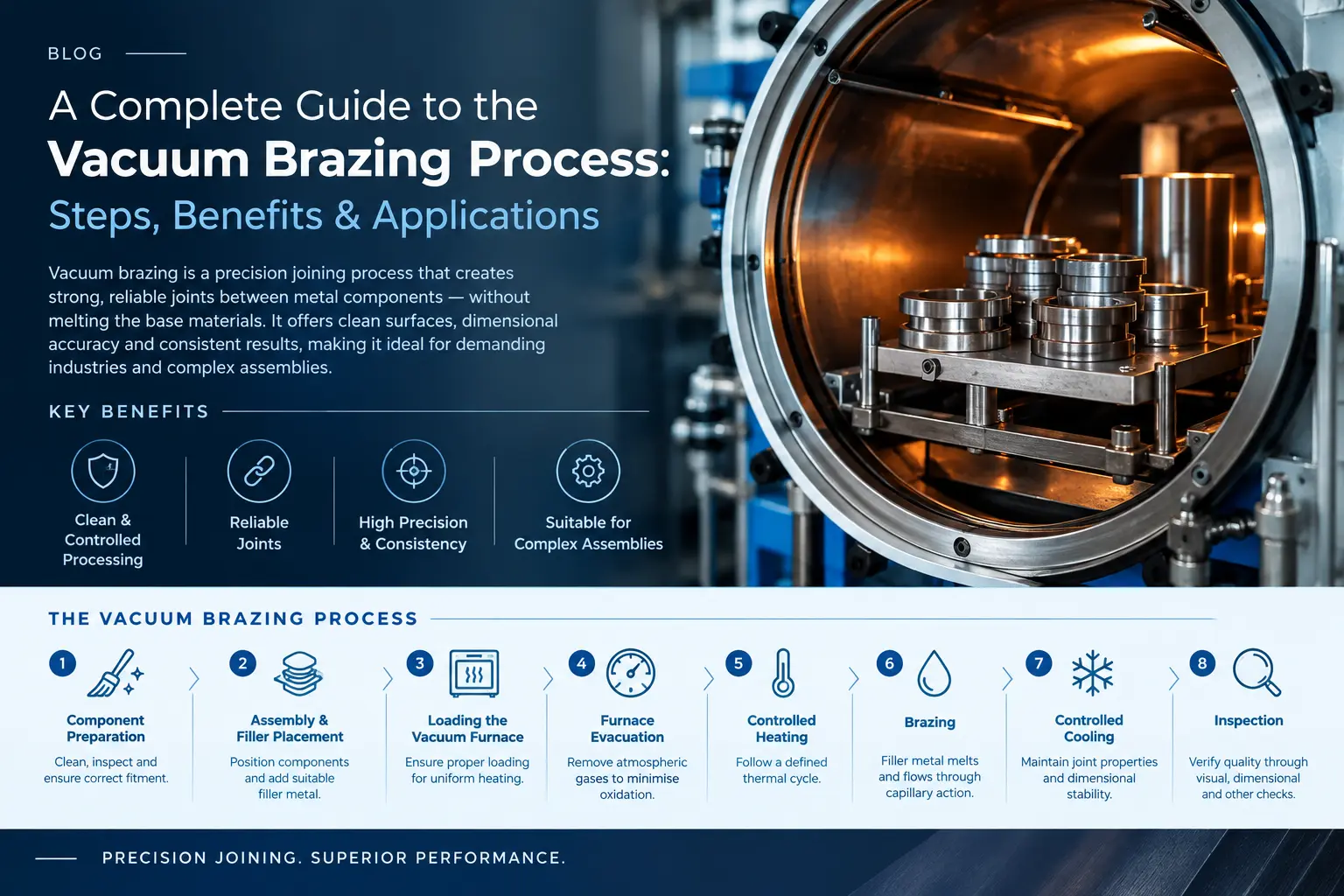
Vacuum brazing is a precision joining process used to create strong and reliable joints between metal components without melting the base materials. It is widely used for applications where clean surfaces, dimensional accuracy, joint consistency, and controlled processing are important.
Unlike conventional brazing, vacuum brazing takes place inside a controlled vacuum furnace. This helps minimize oxidation and contamination during heating and can eliminate the need for flux in many applications. As a result, the process is particularly useful for complex assemblies and components used in demanding industries.
In this guide, we explain the
vacuum brazing process, its major benefits, suitable materials, applications, and important factors to consider when selecting professional
vacuum brazing services.
What Is Vacuum Brazing?
Vacuum brazing is a metal joining process in which two or more components are joined using a suitable brazing filler metal. The assembly is heated inside a
vacuum furnace to a temperature at which the filler metal melts and flows into the joint through capillary action.
The base materials remain below their melting temperatures. Once the filler metal fills the joint and the assembly is cooled under controlled conditions, it forms a strong metallurgical bond.
The vacuum environment helps reduce the presence of oxygen and other atmospheric contaminants. This provides better control over the brazing environment and helps maintain cleaner component surfaces.
How Does the Vacuum Brazing Process Work?
A successful vacuum brazing cycle involves several carefully controlled stages.
1. Component Preparation
Before brazing, components must be properly cleaned. Oil, grease, dirt, oxides, and other contaminants can affect filler-metal flow and joint quality.
The components should also be checked for correct dimensions, joint clearance, and alignment.
2. Assembly and Filler Placement
The components are positioned according to the required assembly design. A suitable brazing filler metal is placed at or near the joint.
Correct filler selection depends on factors such as the base material, operating temperature, required joint strength, and service environment.
3. Loading the Vacuum Furnace
The prepared assemblies are carefully positioned inside the vacuum furnace. Proper loading is important to achieve uniform heating and allow the filler metal to flow correctly.
4. Furnace Evacuation
The furnace is evacuated to remove atmospheric gases. Maintaining the appropriate vacuum conditions helps minimize oxidation and contamination during the heating cycle.
5. Controlled Heating
The components are gradually heated according to a predefined thermal cycle. The heating rate, temperature, and holding time depend on the material and brazing requirements.
6. Brazing
Once the required brazing temperature is reached, the filler metal melts and flows into the joint through capillary action.
Proper temperature control is critical because insufficient heating may prevent adequate filler flow, while excessive heating can negatively affect the components or filler material.
7. Controlled Cooling
After brazing, the assembly is cooled according to the specified process cycle. Controlled cooling helps maintain the required joint properties and dimensional stability.
8. Inspection
The finished assembly can be inspected according to customer and application requirements. Visual, dimensional, and other appropriate inspection methods may be used to verify the quality of the brazed joint.
Why Is Vacuum Used for Brazing?
The vacuum environment is one of the most important aspects of the process.
During conventional heating, oxygen can react with metal surfaces and create oxides. These oxides can interfere with filler-metal flow and joint formation.
Vacuum processing helps minimize these reactions by reducing the presence of atmospheric gases. Depending on the materials and filler system, this can provide:
- Cleaner component surfaces
- Reduced oxidation
- Better filler-metal flow
- Reduced contamination
- Controlled processing conditions
- Consistent results
In many applications, vacuum brazing can also be performed without conventional flux, reducing the possibility of flux-related residues or cleaning requirements.
Key Benefits of Vacuum Brazing
Clean and Controlled Processing
Vacuum brazing provides a controlled environment that minimizes oxidation and contamination during heating. This is particularly useful for precision components where surface cleanliness matters.
Reliable Joints
When the correct filler metal, joint design, temperature, and process parameters are selected, vacuum brazing can produce strong and reliable joints.
Reduced Surface Oxidation
The controlled vacuum environment significantly reduces oxidation during heating compared with processes performed in uncontrolled atmospheric conditions.
Suitable for Complex Assemblies
Vacuum brazing can be used for joining multiple components and complex assemblies where conventional joining methods may be difficult.
Better Process Repeatability
Modern vacuum furnaces allow close control of heating cycles, temperature, vacuum conditions, and cooling. This supports repeatable production results.
Reduced Post-Processing
Because vacuum brazing can produce clean joints with minimal oxidation, certain post-treatment cleaning or surface finishing requirements may be reduced, depending on the application.
Materials Suitable for Vacuum Brazing
Vacuum brazing can be used with a range of engineering materials, depending on their properties and the selected filler metal.
Common examples include:
- Stainless steel
- Tool steel
- Alloy steel
- Nickel-based alloys
- Copper and copper alloys
- Aluminium alloys in suitable applications
- Other engineering materials compatible with vacuum brazing
Filler-metal selection is important and should consider the base material, required joint strength, service temperature, corrosion requirements, and operating environment.
Applications of Vacuum Brazing
Vacuum brazing is used across several industries where precision joining is required.
Automotive
Applications can include precision assemblies, heat exchangers, fuel-related components, and other engineered parts where clean and reliable joints are required.
Aerospace
Aerospace components often require controlled manufacturing processes and high reliability. Vacuum brazing can be used for suitable precision assemblies and heat-transfer components.
Medical
Medical equipment and precision assemblies may require clean joining processes. Vacuum brazing can be considered for suitable components based on material and application requirements.
Electronics & Telecommunications
Vacuum brazing can support the production of precision metal assemblies and components where controlled joining and thermal performance are important.
Tool & Die
Vacuum brazing can be used for suitable tooling assemblies, including joining carbide and steel components where the joint design and materials are appropriate.
Power Generation
The process can also be applied to selected components used in power-generation and high-temperature applications.
Vacuum Brazing vs Conventional Brazing
| Factor |
Vacuum Brazing |
Conventional Brazing |
| Processing environment |
Controlled vacuum |
Atmospheric or controlled atmosphere |
| Oxidation |
Minimized |
Depends on process conditions |
| Flux |
Often not required |
Commonly used in many applications |
| Surface cleanliness |
Generally high |
Depends on process |
| Process control |
Highly controlled |
Varies with equipment |
| Complex assemblies |
Suitable for many applications |
Application dependent |
| Repeatability |
High with controlled cycles |
Process dependent |
The appropriate joining method should always be selected according to the component material, geometry, joint requirements, production volume, and operating environment.
What to Look for in Vacuum Brazing Services
Choosing the right
vacuum brazing services provider is important for achieving consistent results.
Manufacturers should evaluate:
- Vacuum furnace capability
- Furnace size and production capacity
- Temperature control and uniformity
- Vacuum capability
- Experience with different materials
- Filler-metal selection expertise
- Understanding of joint design
- Quality inspection capabilities
- Process documentation
- Ability to support prototype and commercial production
A technically experienced provider can help evaluate the component and determine suitable processing parameters.
Vacuum Brazing as Part of Commercial Vacuum Heat Treatment
For manufacturers requiring multiple thermal processing solutions, a provider offering
commercial vacuum heat treatment capabilities can provide an integrated approach to component processing.
Vacuum brazing can be combined with other controlled thermal treatment requirements depending on the component, material, and manufacturing process. Working with an
experienced commercial heat treatment provider can help manufacturers maintain consistent processing and quality requirements across production batches.
Why Choose IGVT for Vacuum Brazing Services?
IGVT provides vacuum-based
heat treatment and brazing solutions for industrial applications requiring controlled thermal processing.
With suitable vacuum furnace capabilities and technical expertise, IGVT can support manufacturers with precision vacuum brazing requirements across relevant industrial applications.
Manufacturers can discuss their component material, dimensions, joint design, production volume, and performance requirements with the IGVT team to determine an appropriate vacuum brazing approach.
Frequently Asked Questions
1. What is the vacuum brazing process?
The vacuum brazing process involves preparing and assembling components, placing them in a vacuum furnace, evacuating the furnace, controlled heating, melting and flowing of the filler metal into the joint, controlled cooling, and inspection.
2. What are the advantages of vacuum brazing?
Major advantages include reduced oxidation, cleaner surfaces, controlled processing, reliable joints, suitability for complex assemblies, and improved process repeatability.
3. Which materials can be vacuum brazed?
Materials such as stainless steel, tool steel, alloy steel, nickel-based alloys, copper alloys, and selected aluminium alloys can be vacuum brazed when appropriate process conditions and filler metals are used.
4. What is the difference between vacuum brazing and conventional brazing?
Vacuum brazing is performed in a controlled vacuum environment, which helps minimize oxidation and contamination. Conventional brazing may be performed in atmospheric conditions and often uses flux, depending on the application.
5. How do I choose the right vacuum brazing services provider?
Consider the provider's furnace capabilities, material expertise, process control, filler-metal knowledge, inspection facilities, production capacity, and experience with your specific component requirements.
Conclusion
The vacuum brazing process provides a controlled and precise method for joining metal components where cleanliness, dimensional stability, joint reliability, and repeatability are important.
From component preparation and filler placement to controlled heating, brazing, cooling, and inspection, every stage of the process contributes to the final joint quality. This makes vacuum brazing a valuable solution for suitable applications across automotive, aerospace, medical, tooling, electronics, and power-generation industries.
Choosing an experienced provider for
vacuum brazing services can help manufacturers select appropriate materials, filler metals, process parameters, and inspection requirements for their components.
Looking for reliable vacuum brazing services?
Contact IGVT to discuss your component requirements and explore suitable vacuum brazing and
commercial vacuum heat treatment solutions.